Governments worldwide are thinking deeply about artificial intelligence (AI) and its impact on how they serve residents and societies. In July 2026, the first-ever UN Global Dialogue on AI Governance saw states engage in dialogue on both the promise and peril of this transformative technology. However, the future is uncertain, as the technology continues to improve faster than regulation, and AI adoption patterns vary widely between and within countries.
In this rapidly moving environment, governments are being asked to transform at a speed incompatible with the traditional pace of democratic institutions. To do so effectively, developing new capabilities and incorporating different types of intelligence becomes critical. At CPI, we believe in the importance of learning, thinking systemically, and valuing relationships in order to reimagine government and create just futures where everyone can thrive. Relational infrastructure is one of the core capabilities we believe is essential for the government in the age of AI.
Governments strive to deliver for their residents, and AI can help make service delivery more efficient, data-driven, and better coordinated across systems. However, it’s important to distinguish between a tool and a transformative solution. History is full of examples of technological advancements being successful only when accompanied by social and relational infrastructure to support it.
For example, the introduction of the mechanised printing press, an amazing tool, changed how knowledge could be shared, debated and created. Between Gutenberg’s invention and the Renaissance, this technology sparked a wave of social and communication innovations. European society reshaped itself to make the most of this tool for human, scientific and social gains. More people learned to read, new forums for debate were created, scientists standardised scientific diagrams and data, and modern languages were socially accepted. The printing press’s impact relied on new ways of learning, relationships and institutions, which allowed people to make the most of this new tool.
We have lived through more recent examples of this. For example, the development and rollout of the COVID-19 vaccine that saved millions of lives, where scientific innovation was matched by unprecedented collaboration between researchers, governments, healthcare systems and communities. Similarly, the internet continues to function as a global public resource because of the complex, multi-stakeholder governance structures that underpin it.
Too often, we celebrate the technology itself while overlooking the relationships, institutions and shared governance that made its success possible. So, as AI becomes a critical tool for governments, we must ask: what else needs to change to enable a thriving future?
What we’ve learned from working on AI adoption across government
At CPI, we’ve spent many years working with partners on AI adoption across government and civil society. This includes:
- Working with over 70 non-profit and government partners from 24 countries across Europe to upskill 20,000 underserved learners with the AI knowledge and tools needed for long-term professional success through the AI Opportunity Fund.
- Supporting the design of Google.org’s AI Collaboratives to ensure AI tools reach those who are driving positive change. For example, tools like AI-powered wildfire detection can be best used by the institutions and organisations that have the knowledge and expertise to respond.
- Stewarding a $30 million global initiative to help nonprofits, social enterprises, and academic institutions partnering with governments use AI to transform public services for social good.
- And we’re about to launch our report with Amazon Web Services in Australia on how citizen expectations of government might change in the age of AI.
This experience has taught us that the use of AI in government requires relational infrastructure to ensure AI solutions are fit for purpose, adaptive to changing technological and social circumstances, and informed by the real-world experiences of the people impacted.
On the opposite end of the spectrum, technology deployed by government without respect, understanding of relationships or building community trust has led to significant harm to communities. Examples range from Australia’s Robodebt scandal to the role social media played in violence against minorities in Myanmar.
Governments are faced with similar choices in the age of AI: to use technology to foster vibrant, thriving ecosystems of new potential, or choose to exacerbate existing power dynamics and marginalisation under the guise of technological progress.
What do we mean by relational infrastructure?
By relational infrastructure, we mean the structures, processes, institutions, incentives, and deliberate opportunities that allow people to coordinate, communicate, act collectively, share honestly, and form common knowledge through their relationships with each other and with governments. Some examples of relational infrastructure that allow AI to be a useful tool are:
- A well-run citizens assembly that brings together people from a community to deliberate and make informed, shared recommendations for a public body to act on. For example, Taiwan’s vTaiwan initiative led by former Digital Minister Audrey Tang;
- Dedicated space for peers to mentor one another and share opportunities, risks, ethical dilemmas, and emerging AI tools, such as AI Opportunity Fund grantee Hostwriter’s Living Community of Practice for journalists. Rather than focusing solely on technical skills, the community is built around a shift towards strategic sovereignty, helping journalists develop the confidence and judgement to use AI critically and intentionally. Instead of asking, “How do I use this tool?”, participants are encouraged to ask, “Who does this serve, and how can I use it to tell a better story?”
- Thoughtfully designed and executed structures for collaboration, learning and joint problem-solving, like Google.org’s AI Collaboratives. This created a cross-sector ecosystem with clear coordination, governance and leadership designations to ensure an AI predictive tool could be used for the public good. By intentionally convening researchers, governments, industry, philanthropy, and frontline practitioners into enduring and incentivised structures, the Collaborative is greater than the sum of its parts and able to adapt over time to make real impact.
When done well, relational infrastructure is a public asset that creates a web of trust, connections, and support that allows government and citizens to navigate complex problems together. In entangled, wicked problems, this infrastructure also allows for collective sensemaking in the face of overwhelm, building collective resilience.
In the context of artificial intelligence, relational infrastructure is a necessary complement to rapidly evolving technologies. In a recent piece in the MIT Sloan Management Review, Otto Scharmer writes that we risk overreliance on the technology alone:
”The name is intelligence monoculture: the assumption that AI is the only intelligence worth investing in. The diagnosis is that monocultures, sooner or later, collapse. Our response should be to create a second infrastructure, running in parallel to the agentic AI-enabled IT stack: a deep-sensing leadership infrastructure that cultivates the collective capacities to co-sense and co-create at the level of the whole system. With it, AI becomes survivable and useful. Without it, the first infrastructure depletes the very soil it is rooted in — heading toward erosion and, eventually, collapse. “
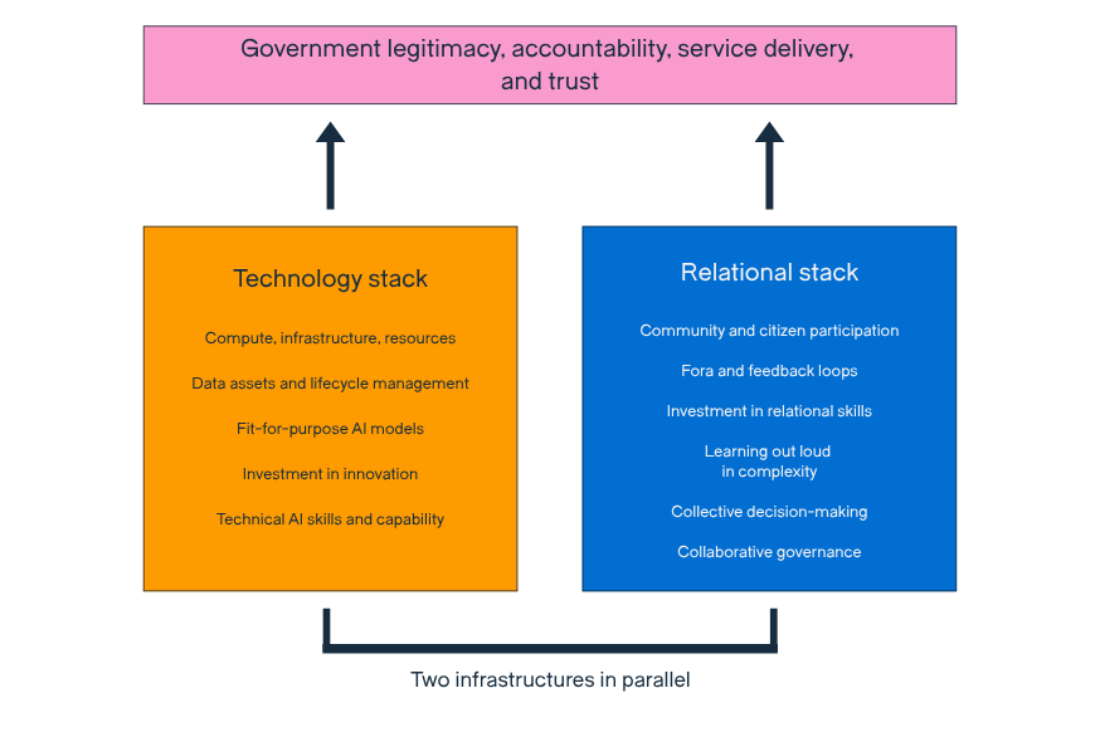
The diagram illustrates our reframe of these two parallel infrastructures as they relate to AI use in government.
Trust in government has always depended on relationships with citizens being valued, legitimate and prioritised. The age of AI raises the stakes because of the scale and speed of transformation, the risk of opaque systems that can lack transparency and legitimacy, and the potential for widespread societal disruption. Relational infrastructure is one way for both government and citizens to make sense of AI-driven societal change together and make informed collective decisions in an otherwise degraded information environment.
- It enables government to learn and adapt in genuine uncertainty. Relational infrastructure builds the feedback loops that let institutions sense what is actually happening and adjust: listening to frontline workers, testing in the open, and treating each deployment as something to learn from rather than a decision to defend. In a fast-moving and uncertain landscape, the capacity to learn together is worth more than the confidence of any static plan.
- It lets government act as a steward of collective capacity. AI can bring more data to bear. Still, it cannot supply the judgement about which trade-offs a community will accept, or the trust and legitimacy needed to act on them. Relational infrastructure allows groups to learn and adapt to form greater collective intelligence, demonstrated in examples like vTaiwan. Government’s role then becomes to act as a steward of this collective capacity.
- It lets government build trust and legitimacy with citizens. AI makes consequential decisions faster and less visibly, resulting in people feeling that a system governs them that they cannot see or question. When AI is embedded in open, participatory processes, it can strengthen legitimacy. When it is deployed as a black box, legitimacy is eroded. Relational infrastructure is what keeps people on the inside of decisions rather than on the receiving end of them.

What can relational infrastructure look like for governments?
For governments, strong relational infrastructure will require a mindset shift towards valuing relationships as essential public infrastructure. We’ve also experienced this from our work with developing relational infrastructure in projects like The Collective, Transformative Evaluation, Social Imagination. And from the work of so many amazing colleagues across the ecosystem, projects like Demos Helsinki’s Humble Government, Governing Together, Presencing Institute, Relationships Project, Dark Matter Labs’s work on agentic capacity, this might look like:
When working with others
- Using AI to support data use and accountability to increase a government’s confidence in more distributed ways of working, such as devolving decision-making power to its smallest appropriate unit, bringing decision-making closer to the communities affected.
- Using AI to help remove some barriers to collaboration by supporting coordination across organisations. For example, in social services, AI could analyse securely shared data across providers, help staff identify patterns, coordinate support and target interventions more effectively. Using AI-supported feedback loops across any service could speed up learning and promote a focus on prevention, rather than reaction.
- Having strong relational infrastructure means that when governments deploy AI-enabled, resident-facing tools, such as chatbots, they are designed collaboratively with empathy. By involving residents in ongoing governance, governments can build in regular feedback loops and keep iteration as part of the implementation.
To succeed, governments will also need to address existing trust deficits that could be amplified as AI plays a more visible role in public life. A response grounded in relational infrastructure would start with generous funding for collaborative governance approaches within grant programmes. It would also include improving civil servants’ capability to partner effectively with communities. Critically, this would require acknowledging past harms and power imbalances while creating lasting channels for public participation and accountability.
Internally
This could result in behaviours such as working across siloed departments, changing KPIs to include learning and reflection, incentivising relational skills building, thinking in longer time horizons and listening to Indigenous knowledge holders who have been practising relationality for millennia and are applying this lens to how we think about working with AI.
- AI could strengthen collaboration across government by surfacing connections between teams, programmes, and datasets that would otherwise remain hidden. Rather than each department working in isolation, AI could help identify shared outcomes, opportunities for coordinated action, and make interdependencies more visible, making it easier for public servants to respond to complex challenges.
- AI could support learning and iteration, and increase transparency by translating complex organisational performance data into accessible, real-time dashboards for public servants and residents alike. This shared visibility makes it easy to identify progress and challenges while driving accountability.
- AI could support a culture of continuous learning to support innovation and help institutional memory by synthesising insights from previous pilots, evaluations, consultations, and projects. This could identify recurring barriers, suggest connections to similar work across the organisation and reduce duplication.
Building relational capacity in government in the age of AI
Like any human interaction, engaging through relational infrastructure can feel like joy, frustration, love, disappointment, awe, fear, complexity and complication. Unlike managerial and technological tools, this humanity makes relational engagement hard to control, predict, put on a balance sheet, and create a business case for. Relational approaches demand “institutions which work with human frailty rather than the fiction of peak performance.”
AI may generate efficiencies that reduce administrative burden, and the compounding value of these gains is the freeing up of organisational and fiscal space to invest in relational infrastructure that is necessary for legitimate, trusted resident-government actions.
As Isabelle C. Hau explains in her article ‘Welcome to the Era of Relational Intelligence’
“As AI begins to transform education, work and social life, we need to focus on developing and expanding capacities essential for human flourishing…
Building a better world for relating will not be easy. Our society still undervalues relational skills. Our institutions reward efficiency over connections. Inequality ensures that connection-rich environments are often reserved for the privileged, who are also protected from some of the downsides of isolation. And the lure of machine intimacy, … will only grow stronger.”