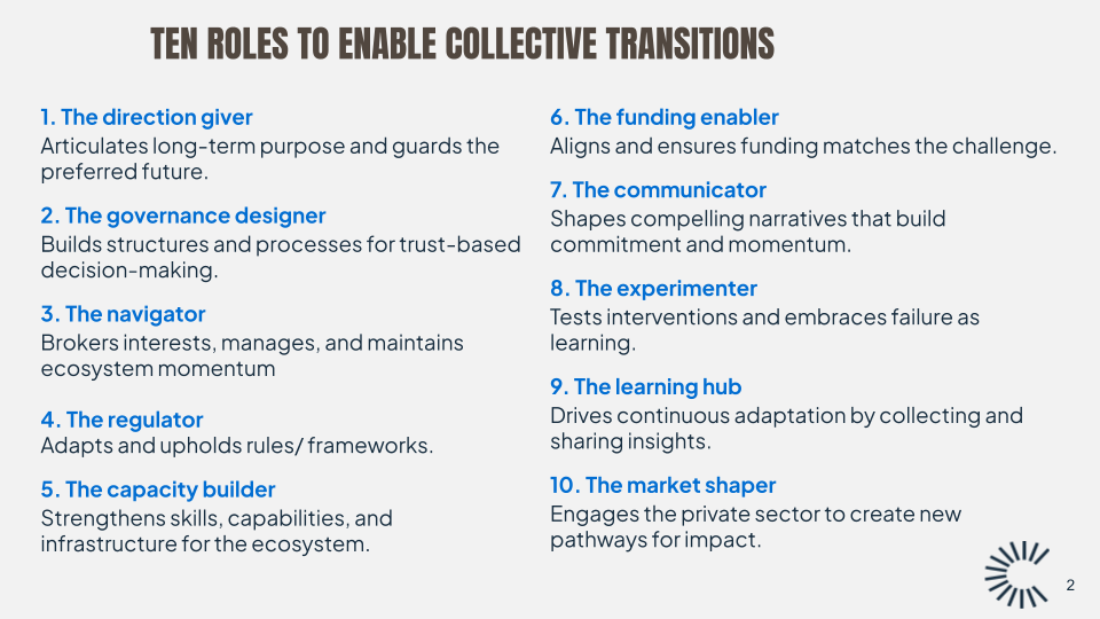
Government remains our best option for doing good at scale, but meeting the challenges of our times requires reimagining its role, as well as the role of citizens, communities, and others in the sector. Drawing on the work of many colleagues, communities and collaborators, Christian Bason began this work with colleagues in the WHO publication Scaling Innovations in Public Health Systems. He later continued it in his essay for the Creative Bureaucracy festival, The Age Of Transitions, From Small To Big Missions, where he identifies ten roles that “help institutions and their partners turn shared ambitions into collective action”.
On 27th October, the Centre for Public Impact hosted a conversation with Christian Bason and individuals from across our networks about his essay for the Creative Bureaucracy festival, and the relevance of these ten roles within the Australian context. Watch the recording.
The webinar
The invitation was to join us for an hour-long interactive dialogue with Christian, during which Christian shared a high-level summary of the background to this work and an introduction to the roles themselves (participants received the essay before the event to familiarise themselves beforehand). We then invited participants to respond to two ranking questions using Mentimeter:
- Order these roles according to what would be most impactful for the Australian Public Sector.
- Order these from most possible (or already happening) to most difficult to enact right now.
We opened a conversation about each question: What makes this hard? Are there roles that support each other and are interlinked? To what extent do you agree with the aggregate ranking of the group and why?
What did we discover together?
What is impactful?
The most comparatively impactful roles of government in transitions identified by this group were the Governance Designer, the Communicator and the Direction Giver. Clearly, governance is one of the core tasks of a government, but when governments get governed, this dictates how power flows and what behaviour is acceptable.
The Direction Giver received some attention, with a suggestion to rename it Direction Shaper, which was met with sounds and emojis of agreement across the group. This also reflects the systems stewardship approach, which is a core statutory value within the Australian Public Service. Interestingly, the Regulator was identified as the least impactful role, despite regulation also being identified as the best lever government has for change.
What is possible (in the current system)?
When asked about what was possible, The Regulator moved up from tenth place in impact to third place. The group reflected that, to be more impactful, regulation may need a reframe. What might be possible through regulation if it were communicating differently, connecting regulatory activity to an aspirational direction, explaining why a regulation is necessary in positive terms? This might mitigate the negative connotations and perceptions of regulation as being slow/nay-sayers/redtape etc. Is there potential for more effective regulation if it were used in an anticipatory or dynamic way?
The market shaper was placed 8th in the impact ratings and 10th in the possibility ratings. Some participants wondered whether this represented a missed opportunity in Australia to create meaningful partnerships with the private sector for public good.
It also feels important to note that, of course, all of these roles are possible in government. This is never clearer than in times of crisis, where extraordinary things become possible, that revert to impossible once the crisis has passed. The group remained relatively upbeat throughout the conversation, with Christian sharing in closing that he remains very hopeful about the future of government.
CPI Team reflections
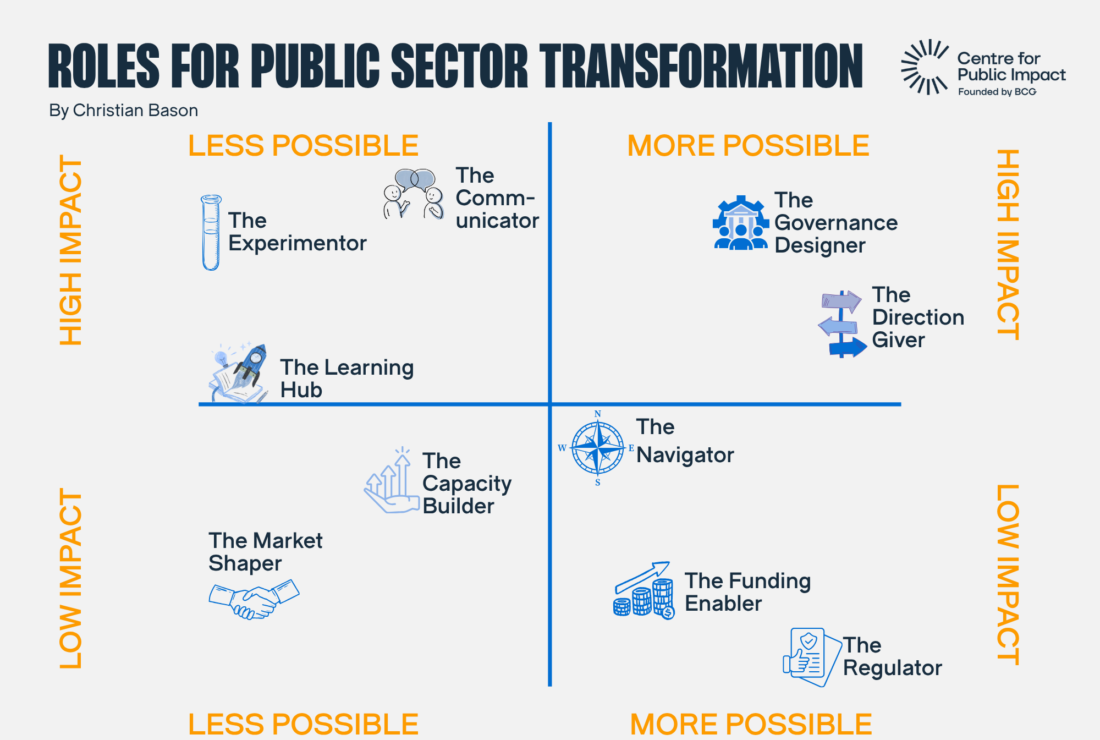
This was a thoroughly enjoyable, if extremely brief, conversation, which of course continued in the CPI office after the Zoom room closed. We were interested in the roles identified as comparatively high impact but perceived as difficult to enact in the current context. To help us visualise the spread of impactful and possible roles, we plotted the aggregate scores onto a matrix.
This matrix makes it clearer that certain roles were identified as comparatively more impactful but seen as less possible.
In our work as a learning partner to government, we see firsthand that the commendable drive for efficiency with public money means that it’s hard to justify time not spent in ways that are directly contributing to action (please note we are not saying impact!). It’s challenging to carve out time to learn, share experiences and insights from attempts that turned out in unexpected ways. It’s challenging to communicate clearly and openly when there are spoken and unspoken rules about who you are allowed to speak to as a public servant. You can’t co-create a narrative with those you are not meant to speak to. Government is also operating in a high-stakes and risk-averse environment, which makes experimentation both essential and enormously difficult.
Seeing these roles in the top left-hand quadrant of this matrix confirms our commitment to the core beliefs of CPI, that we need to work alongside governments to
- Create the conditions where they can build relationships through two-way communication, to enable them to trust, share power and recognise our interdependence
- Create the hard and soft infrastructure that enables safe and action-oriented learning and adaptation
- Recognise the complex nature of our world, that requires constant experimentation, learning and adaptation to create shifts towards societal good.
We have seen incredible changes within government when these beliefs are enacted, but we are not naive about how hard it is to navigate these shifts. If you want to work with us, we’d love that. Get in touch!
Resources shared during the discussion
- The Test, Learn and Grow playbook from the Cabinet Office in the UK
- Public Servant Pulse
- The WHO report Scaling Innovations in Public Health Systems, which distinguishes between roles and capacities.
- Christian’s essay The Age Of Transition From Small To Big Missions, within the Creative Bureaucracy Festival book Where Next and How?